Single prompts cannot handle multi-step work
03 / Services / Agentic AI
Agentic AI DevelopmentAgents with clear boundaries.
Autonomous, tool-using AI agents and multi-agent systems that plan, act, and complete real business workflows end to end.

01 / The problem
What usuallygets in the way.
Design multi-step AI agents that plan, use tools and hand off to people - with guardrails, tracing and review where it matters.
Agents take actions nobody can trace or undo
Tool integrations are brittle and untested
02 / What I build
What you get.
- A supervisor-and-specialist agent design
- Tool integrations with guardrails and approvals
- Traces, evaluations and a human-review path
03 / How it works
From a request to a reviewed action
A typical architecture for this kind of work. Scroll to follow the flow, or hover a stage for detail.
Request
A goal in plain language, with user context.
Planner
A supervisor splits the goal into steps.
Tools
Specialist agents call APIs, search and databases.
Memory
State carried across steps and sessions.
Guardrails
Policies check inputs, outputs and actions.
Human review
Approval for anything costly or irreversible.
Action
The result is delivered and fully traced.
04 / In depth
The details.
I design and ship agentic AI systems - LLM-powered agents that reason, call tools, use memory, and take real actions instead of just answering questions. From single task-runners to orchestrated multi-agent teams, I build agents that reliably complete end-to-end business workflows with the right guardrails.
Autonomous Agents
Goal-driven agents that plan multi-step tasks, choose and call tools (APIs, databases, search, code execution), observe results, and self-correct until the objective is met.
Multi-Agent Orchestration
Coordinated agent teams - planner, researcher, executor, reviewer - built with LangGraph and MCP so complex work is decomposed, parallelised, and recombined predictably.
Tools, Memory & MCP
Model Context Protocol servers, function/tool calling, vector and episodic memory, and retrieval so agents stay grounded, remember context across turns, and act on your live systems.
Human-in-the-Loop & Guardrails
Approval gates, cost/rate controls, evals, and observability so autonomous behaviour stays safe, auditable, and production-ready.
05 / Tech stack
Tools I usefor this work.
- LangGraph
- MCP
- OpenAI
- Claude
- Groq
- LangSmith
More in Agentic AI
Related articles
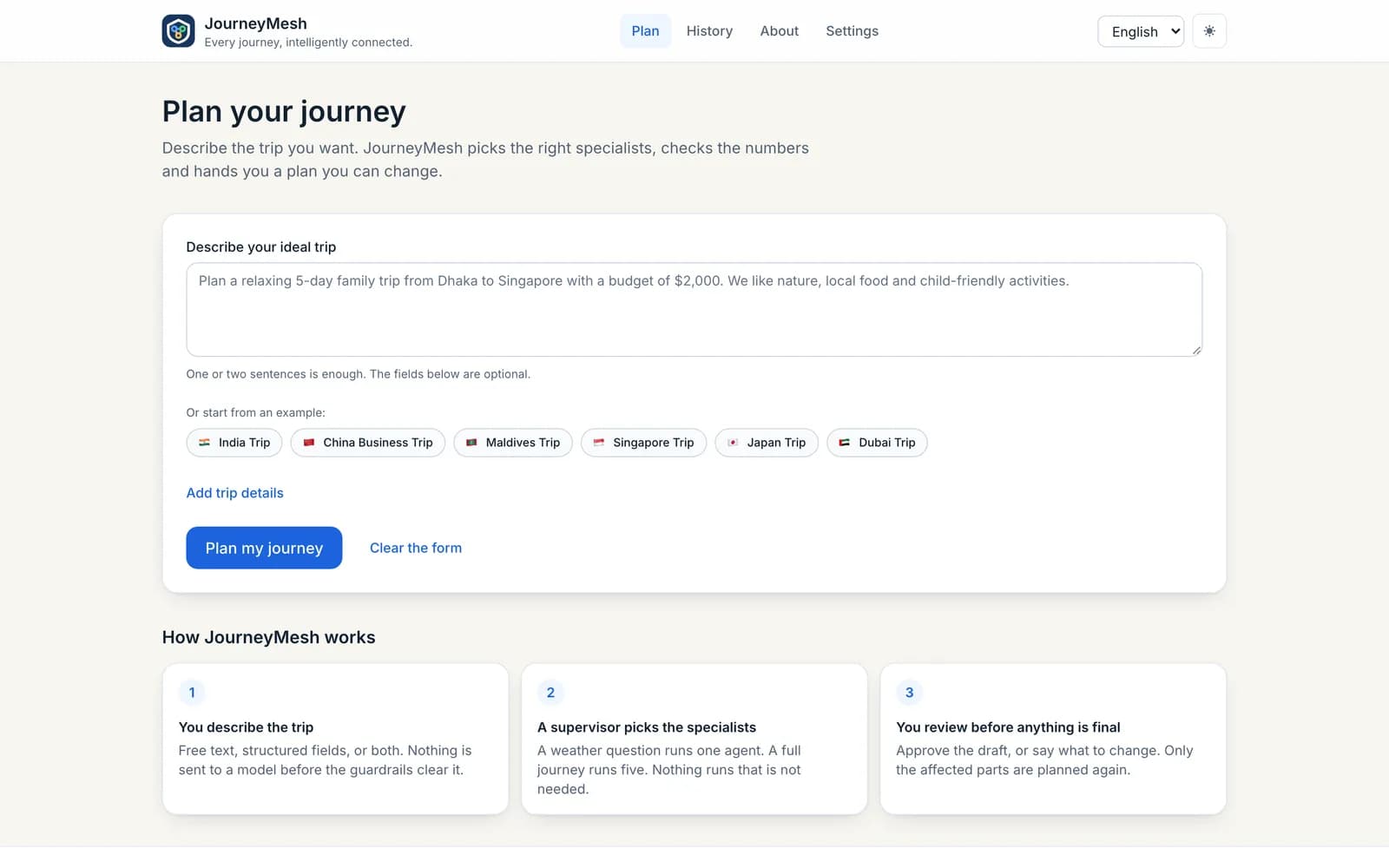
07 / FAQ
Common questions.
What is an AI agent?
An AI agent is a language model that can plan steps and use tools, such as searching data, calling APIs or updating records, to complete a task. Useful agents have clear limits on what they may do and hand decisions to a person when needed.
Does every AI application need an agent?
No. A fixed workflow with a few model calls is cheaper, faster and easier to test when the steps are known in advance. An agent is worth it when the next step depends on what earlier steps found.
Can you build AI agents for law firms or healthcare teams?
Yes. Examples are agents that triage intake requests, gather case or patient documents, draft summaries and update the CRM. In regulated work they act only within approved tools, log every action, and leave final decisions to a qualified person.
Agentic AI
Need Agentic AI Development?Let’s scope it together.
Tell me about the goal, the data and the constraints. I’ll reply with questions and a practical first step.